- Ajay's Quest
- Posts
- The $1T Question

As we come into a new year, I’ve been thinking less about how fast we’re moving and more about where we’re actually heading.
We’ve been shipping experiments, stacking wins, and doing the work required to earn the right to play the next stage of the game. That part matters.
But it also forced a more uncomfortable reflection:
If an experiment succeeds, what does it actually prove?
Because momentum without meaning is just activity. And it’s dangerously easy to mistake progress for direction.
We’ve always said we want to build a truly massive company. If that ambition is real, then it’s worth asking whether the things we’re optimizing for today are aligned with where we actually want to end up.
The Question I Can’t Shake
We’re currently running an experiment in a product category that is already crowded. Many companies sell it. Many sell it well.
However after launching it, we realise regardless of the outcome of the experiment, the result doesn’t drive towards where we want to go.
❌ If it fails, it proves our marketing isn’t good enough.
✅ If it succeeds, it proves we can do ecommerce competently.
Neither outcome proves we are building something generational.
Neither outcome proves we are on a trillion dollar trajectory.
And that matters just as much as the revenue number.
Local maxima are dangerous
There is a type of success that quietly kills ambition.
It feels good. It validates you. It prints money.
And it locks you into a ceiling.
At EntryLevel, we knew we could sell $10k bootcamps. The demand was obvious. The unit economics worked. We could have built a very solid business doing exactly that.
We chose not to. Why?
Because our stated ambition was to retrain one billion people.
Bootcamps do not scale to a billion people. They are labor-heavy. They compress margins. They resist automation. They optimize for near-term revenue at the cost of long-term scale.
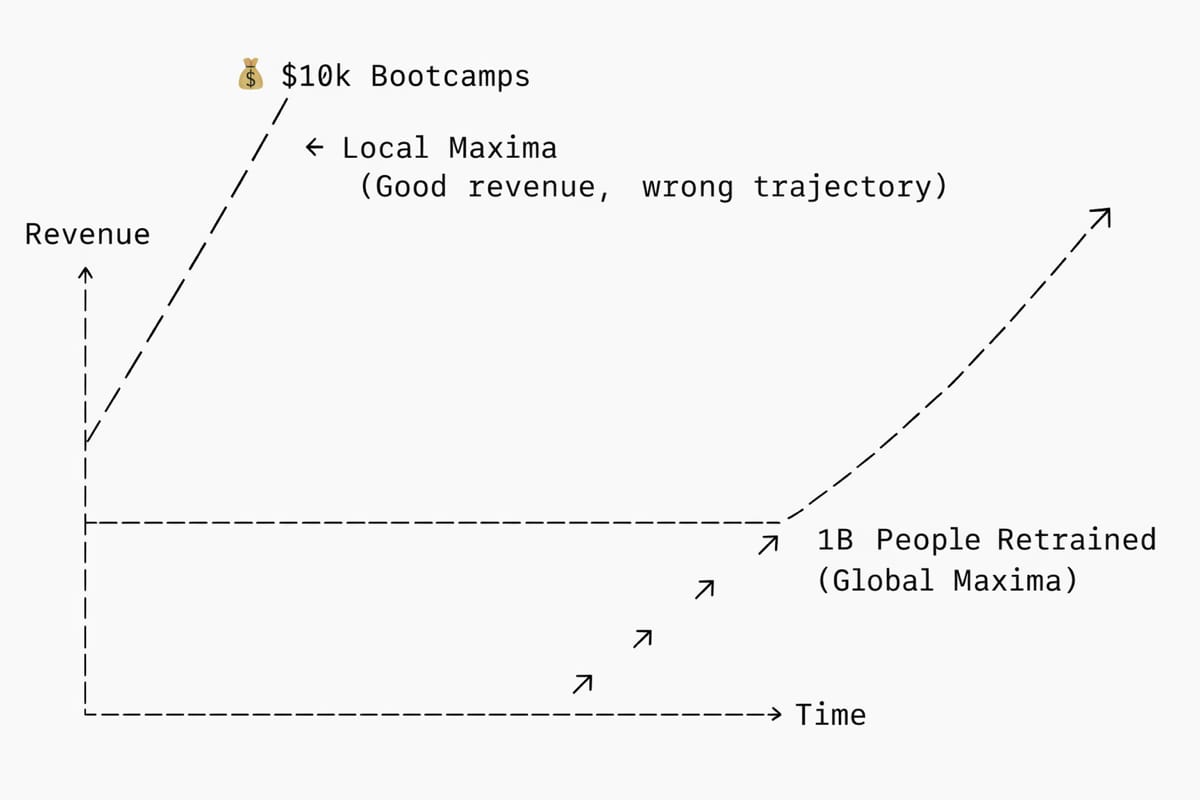
They were a local maximum. So we chose the harder path. The one that looked worse on paper in the early days. The one that preserved optionality for global scale.
That decision defined everything that came after.
What $1T Companies Actually Do
When you study companies that eventually become massive, a pattern shows up. They do not win by being slightly better versions of existing players.
They win by owning a wedge so deeply that it becomes an operating layer for an entire category.
Apple
Apple didn’t try to be a better PC company. It created a tightly integrated hardware and software experience so opinionated that users slowly moved their entire digital life inside it. The ecosystem came later, after taste and control were earned.
Google didn’t just organize information. It owned the starting point of the internet. By winning the first query, it earned the right to expand into ads, browsers, mobile operating systems, and now AI.
Figma
Figma became the multiplayer operating system for design.
Shopify
Shopify became the anti-Amazon infrastructure for independence.
Different markets. Same underlying playbook.
The $1T Pattern
1. Category Creation
They do not enter existing markets and try to be 10 percent better. They define a new category with new rules. Category creation is not about messaging. It is about changing what the product is. Once you do that, comparison breaks. Pricing becomes flexible. Attention compounds.
2. Behavior Change
New categories only matter if they change what people do by default. Behavior change is the moment where a product stops being a tool and starts becoming infrastructure.
3. Ecosystem Lock-in
Once behavior shifts, something subtle happens. People don’t just use the product. They move more of their life into it. Files. Photos. Payments. Workflows. Identity. This is not lock-in through contracts or dark patterns.
It is lock-in through convenience and coherence. At this stage, the product is no longer a feature. It is a place.
4. Compounding Value
The final phase is where outcomes diverge dramatically. The user gets more value over time without needing to be resold. This is the difference between growth and escape velocity.
Closing Thoughts: Earn the Right
None of this means skipping the basics. You don’t start at category creation. You earn your way there.
But if your ambition is large, you have to be deliberate about how early decisions shape your trajectory. Product differentiation and category creation are not things you bolt on later. They are paths you either stay aligned to or quietly drift away from.
The real question is not whether you can capture short-term value, but whether today’s choices are building a system that can scale tomorrow. Sometimes that means trading off near-term revenue to fund the future you actually want to build.
Thinking about that trade-off early is what keeps you from getting stuck at a local maximum.
Until next time,
Ajay
🧠 Ajay’s Resource Bank
A few tools and collections I’ve built (or obsessively curated) over the years:
100+ Mental Models
Mental shortcuts and thinking tools I’ve refined over the past decade. These have evolved as I’ve gained experience — pruned, updated, and battle-tested.100+ Questions
If you want better answers, ask better questions. These are the ones I keep returning to — for strategy, reflection, and unlocking stuck conversations.Startup OS
A lightweight operating system I built for running startups. I’m currently adapting it for growth teams as I scale Superpower — thinking about publishing it soon.Remote Games & Activities
Fun team-building exercises and games (many made in Canva) that actually work. Good for offsites, Zoom fatigue, or breaking the ice with distributed teams.
✅ Ajay’s “would recommend” List
These are tools and services I use personally and professionally — and recommend without hesitation:
Athyna – Offshore Hiring Done Right
I personally have worked with assistants overseas and built offshore teams. Most people get this wrong by assuming you have to go the lowest cost for automated work. Try hiring high quality, strategic people for a fraction of the cost instead.Superpower – It starts with a 100+ lab tests
I joined Superpower as Head of Growth, but I originally came on to fix my health. In return, I got a full diagnostic panel, a tailored action plan, and ongoing support that finally gave me clarity after years of flying blind.