- Ajay's Quest
- Posts
- Rethinking Landing Pages


I’m currently remaking our landing page, and as I was doing it, I started documenting the process for my team so they can repeat it in the future.
What surprised me is that I couldn’t find a genuinely good guide on how to think about landing pages.
There’s plenty of content on:
Copy formulas
Conversion rate optimization tricks
Button colors and hero layouts
But very little on the underlying mental model. The part that actually determines whether a page works or not. So this is my attempt at a different kind of guide. Less about tactics. More about reasoning.
Step 1: Start With Belief, Not Layout
Before I touch Figma, copy, or components, I ask a single question:
When someone leaves this page, what do we want them to believe?
Not what they should click.
Not what feature they should remember.
What belief should be installed in their head.
Every section either reinforces the belief or dilutes it.
Below is the framework I now use when designing or reviewing landing pages. I think of each page as choosing a belief archetype and committing to it.
You can have multiple landing pages across a site.
But each page should usually anchor on one dominant belief.
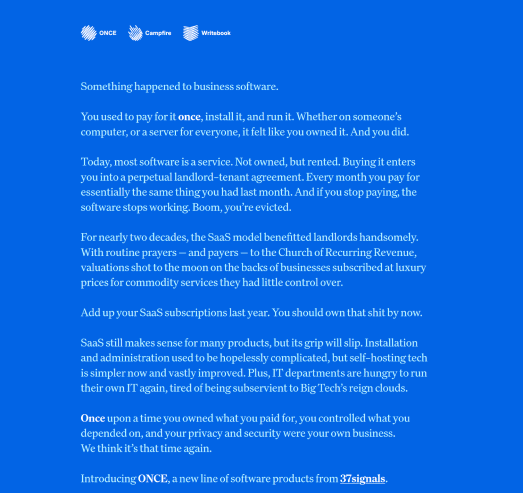 This is a great page by Jason Fried for once.com (they changed it though!) 1. Systems & Philosophy-Led“This company understands the problem better than anyone else.” This archetype sells a worldview. You are not buying a product. You are buying how the company thinks. |  myjuniper.com which is extremely outcome focused 2. Outcome or Benefits-Led“This will make my life meaningfully better, fast.” This archetype optimizes for emotional pull over explanation. The page focuses on the end state, not the mechanism. |
 growth.design does this well 3. Proof or Credibility-Led“People like me trust this.” This archetype front-loads trust. Social proof, results, and authority do the heavy lifting. | 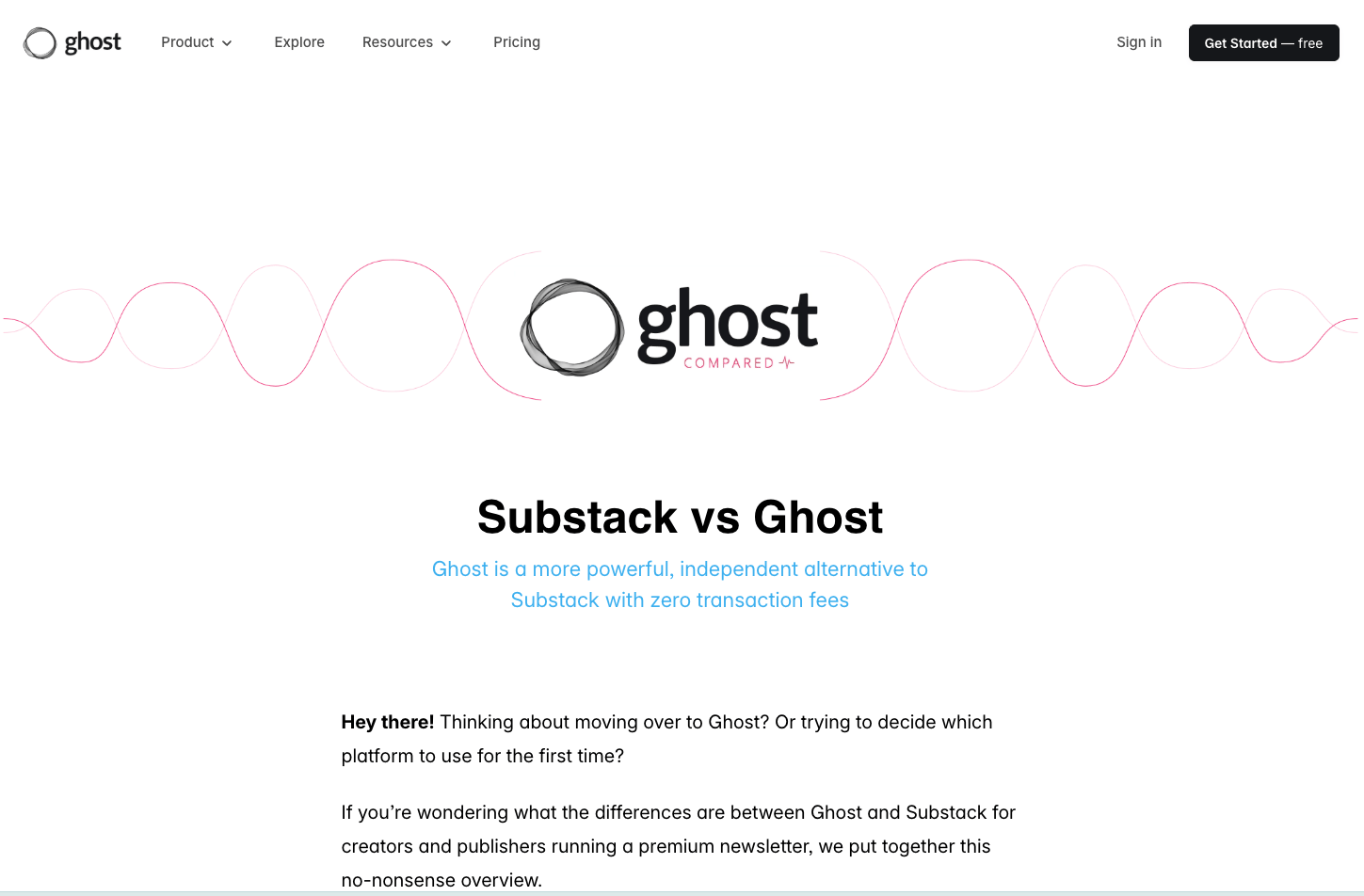 love this page from ghost: https://ghost.org/vs/substack/ 4. Comparison or Decision-Led“This is clearly the right choice.” This archetype helps users decide. It reframes alternatives and resolves objections directly. |
5. Feature or Capability-Led“This is serious, robust, and complete.” This archetype emphasizes depth and completeness. It reassures analytical buyers nothing important is missing. |  Canva.com has so many paths in, it feels very personal 6. Personal or Journey-Led“This feels built for me.” This archetype adapts to the user. The experience unfolds based on who they are and what they need. |

Step 2: Bottom Up Reality
Once you have a belief hypothesis, you validate it with behavior. Look at the data like a detective, not a validator.
Things I always check:
Click maps: what do people instinctively click?
Scroll depth: where is the big drop-off?
Attention leaks: what pulls focus without explanation?
Hesitation points: where do people slow down or abandon?
CTR to secondary pages: what curiosity paths exist naturally?
Good landing pages are not opinionated guesses. They are conversations with revealed behavior.
Ajay’s Quest is finally taking sponsors for 2026!
$ ajaysquest --sponsors

> Checking alignment...
> Audience quality: high
> Attention span: long
> Trust level: earned

> Only a few sponsors approved per year.
> If this is you, you already know. Email back.
Step 3: The Psychological Sequence
Regardless of industry, most great pages follow the same mental flow. You can break the rules. Novelty works. But you should know what you’re breaking.
The sequence:
┌──────────────────────────────┐
│   Curiosity-Invoking Hero    │
│                              │
│  earns the next sentence     │
└───────────────┬──────────────┘
                │
                ▼
┌──────────────────────────────┐
│     Problem Agitation        │
│                              │
│  name the frustration        │
│  normalize it                │
│  make them feel seen         │
└───────────────┬──────────────┘
                │
                ▼
┌──────────────────────────────┐
│       Clear Solution         │
│                              │
│  product = obvious answer    │
│  to the surfaced problem     │
└───────────────┬──────────────┘
                │
                ▼
┌──────────────────────────────┐
│        How It Works          │
│                              │
│  reduce uncertainty          │
│  replace mystery with clarity│
└───────────────┬──────────────┘
                │
                ▼
┌──────────────────────────────┐
│          Evidence            │
│                              │
│  proof                       │
│  social signal               │
│  results                     │
│  credibility                 │
│                              │
│  (then more evidence)        │
│  (then more again)           │
└──────────────────────────────┘
This is a simple but effective formula for a great landing page.
Closing Thoughts
Landing pages are not about persuasion tricks. They are about installing a belief so cleanly that the action feels inevitable.
If you’re arguing with the user, you’ve already lost. If you’re clarifying a belief they already want to hold, you’re winning.
That’s how I think about landing pages.
Until next time,
Ajay
🧠 Ajay’s Resource Bank
A few tools and collections I’ve built (or obsessively curated) over the years:
100+ Mental Models
Mental shortcuts and thinking tools I’ve refined over the past decade. These have evolved as I’ve gained experience — pruned, updated, and battle-tested.100+ Questions
If you want better answers, ask better questions. These are the ones I keep returning to — for strategy, reflection, and unlocking stuck conversations.Startup OS
A lightweight operating system I built for running startups. I’m currently adapting it for growth teams as I scale Superpower — thinking about publishing it soon.Remote Games & Activities
Fun team-building exercises and games (many made in Canva) that actually work. Good for offsites, Zoom fatigue, or breaking the ice with distributed teams.
✅ Ajay’s “would recommend” List
These are tools and services I use personally and professionally — and recommend without hesitation:
Athyna – Offshore Hiring Done Right
I personally have worked with assistants overseas and built offshore teams. Most people get this wrong by assuming you have to go the lowest cost for automated work. Try hiring high quality, strategic people for a fraction of the cost instead.Superpower – It starts with a 100+ lab tests
I joined Superpower as Head of Growth, but I originally came on to fix my health. In return, I got a full diagnostic panel, a tailored action plan, and ongoing support that finally gave me clarity after years of flying blind.